Industrial inspection teams often need to detect heat anomalies, inspect distant components, and document defects without putting people in risky positions. A multi-sensor UAV inspection payload makes that work faster and safer by combining thermal imaging, wide-area awareness, zoom detail, and precise distance measurement in one aerial system.
For utility operators, solar asset managers, industrial inspection providers, and infrastructure teams, the right payload does more than capture images. It helps crews identify potential faults earlier, inspect hard-to-reach assets more efficiently, and collect clearer data for maintenance decisions. That is why payload choice matters just as much as the drone platform itself.
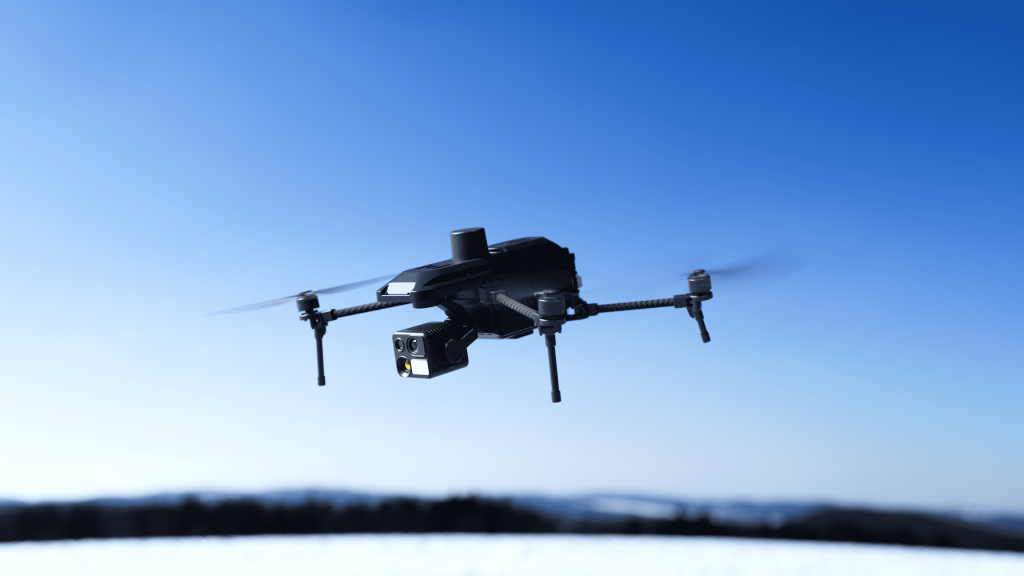
What Is a UAV Inspection Payload?
A UAV inspection payload is the sensor and camera system mounted on a drone to support aerial inspection tasks. In industrial environments, that payload may need to do several jobs at once: detect abnormal heat, provide overall scene awareness, zoom in on distant components, and help the operator confirm location and distance to target.
This is why many inspection teams move beyond single-camera systems. A standard visual camera may be useful for general observation, but inspection work often requires more detailed and more reliable information. If an operator needs to check a hotspot on a substation component, inspect a solar module string, or observe structural details on a tower from a safe distance, the payload has to support that mission directly.
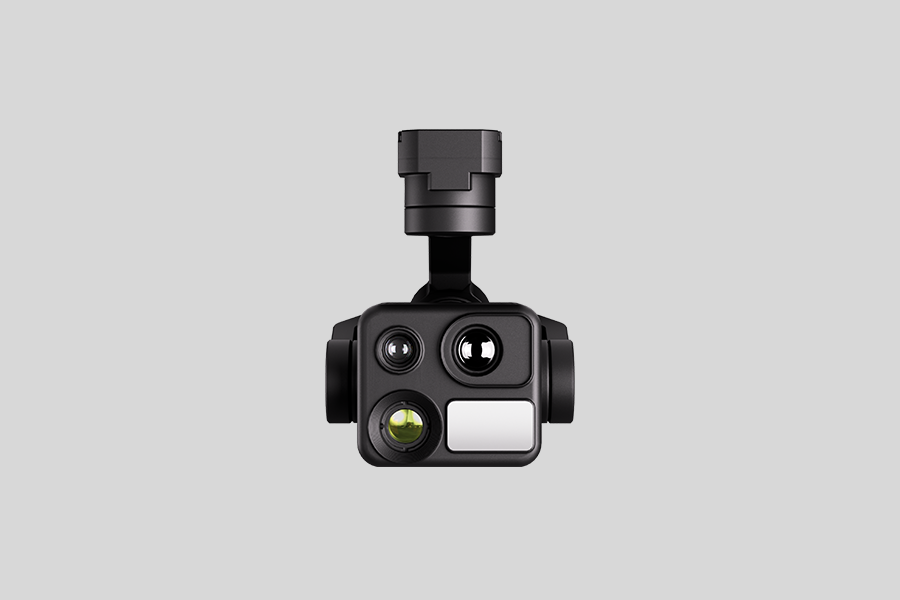
Why Inspection Teams Need More Than a Standard Drone Camera
Many assets are difficult, expensive, or risky to inspect using traditional methods. Power infrastructure, rooftops, towers, industrial facilities, and remote sites can all require crews to work at height, enter restricted areas, or shut down operations temporarily. UAV inspections help reduce those burdens, but only if the payload is capable enough for the job.
A standard drone camera may show a general view of an asset, but it may not reveal the temperature anomaly behind a developing issue. It may not allow an operator to inspect small details from a safe stand-off distance. It may also force the aircraft to fly closer than desired, especially when operators are trying to confirm faults visually.
For inspection teams, a more capable payload can improve both efficiency and decision quality by helping operators:
- detect overheating components
- inspect distant assets without flying too close
- document visible and thermal findings in one workflow
- reduce time spent on manual access methods
- improve safety for personnel in the field
Single-camera vs multi-sensor payload comparison
| Inspection need | Standard camera payload | Multi-sensor inspection payload |
|---|---|---|
| Detect heat anomalies | Not supported | Supported with thermal imaging |
| Understand full asset context | Limited | Supported with wide-angle view |
| Inspect distant details safely | Limited | Stronger with optical and hybrid zoom |
| Maintain target lock during movement | Manual only | Improved with AI tracking |
| Confirm distance to target | Usually unavailable | Supported with laser rangefinder |
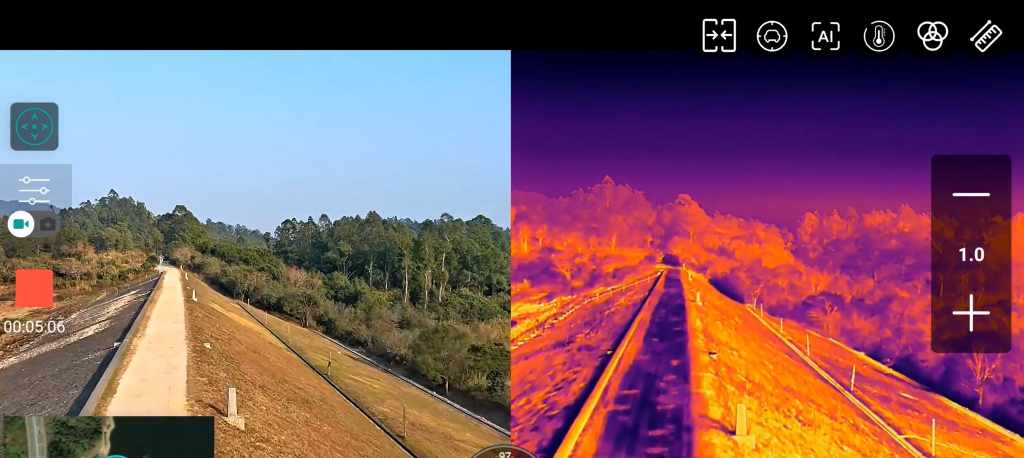
| Compare visible and thermal views | Usually unavailable | Supported with fusion or split-screen workflows |
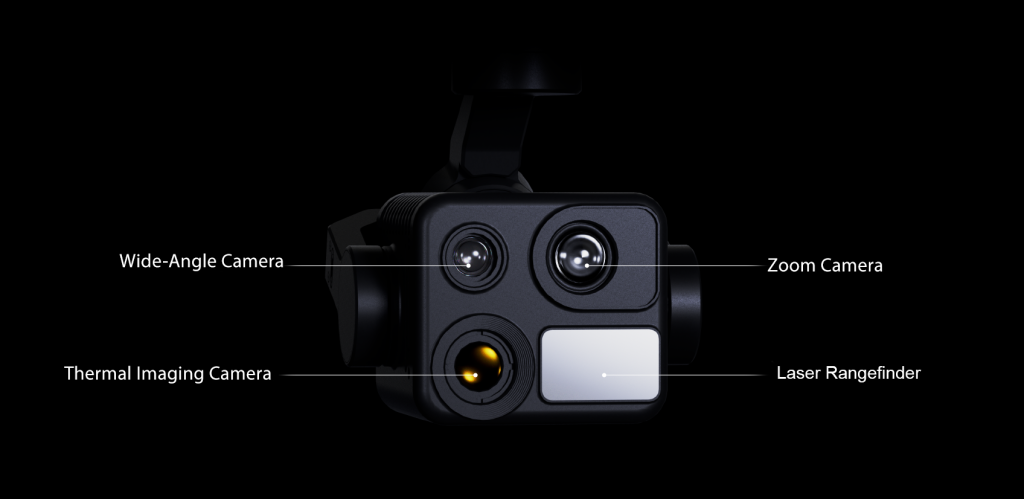
Why Thermal, Wide-Angle, Zoom, AI Tracking, and Laser Rangefinding Work Better Together
Inspection work rarely depends on a single type of view. Operators often need to locate a possible issue, understand the broader context around it, examine it in detail, and confirm where it is. A multi-sensor inspection payload supports that full process more effectively than a single-sensor setup.
Thermal imaging for anomaly detection
Thermal imaging helps operators identify abnormal temperature patterns that may signal electrical faults, heat loss, overloaded equipment, or component degradation. In inspection workflows, thermal is often the fastest way to flag where attention is needed first.
This is especially useful in applications such as substation inspection, solar farm inspection, and industrial equipment checks, where heat patterns can reveal problems before visible damage becomes obvious. For teams evaluating a thermal camera for drone inspection, thermal performance is often the first filter because it determines how effectively anomalies can be identified before a closer visual review.
Wide-angle view for scene awareness
A wide-angle camera helps the operator understand the full inspection scene before zooming in. This matters when inspecting complex assets such as transmission structures, industrial plants, rooftops, or large solar arrays, where context is important for navigation and efficient target selection.
Telephoto zoom for long-range detail
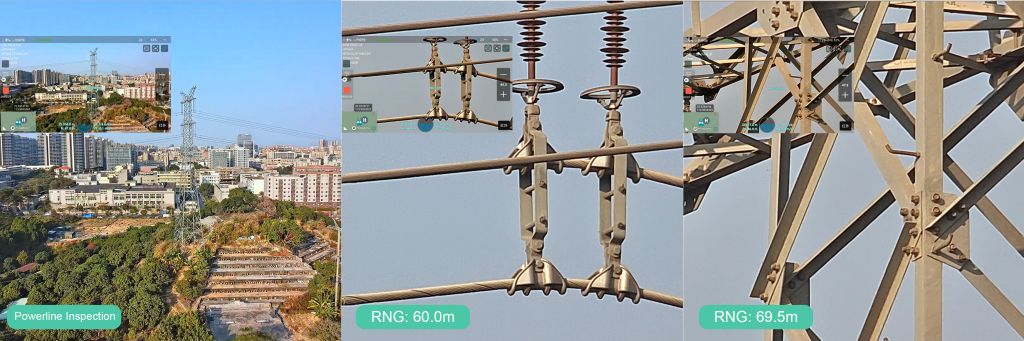
Zoom capability allows operators to inspect components from a safer and more practical stand-off distance. Instead of moving the drone very close to the target, teams can capture details on insulators, connectors, fasteners, panels, roof structures, and facade elements while maintaining more controlled flight conditions. This matters when an industrial drone camera is being used around sensitive infrastructure or in windy environments where stable stand-off inspection is preferred.
AI tracking for target lock and workflow efficiency
AI tracking helps operators keep the inspection target centered and continuously observed during movement or repositioning. On complex assets, this can reduce manual camera adjustment and help the crew stay focused on the condition being inspected rather than constantly reacquiring the target.
For missions that involve moving vehicles, perimeter assets, or repeated visual checks across large sites, smart target recognition and tracking can improve inspection efficiency and support more consistent footage capture.
Laser rangefinder for target confirmation
A laser rangefinder helps the operator confirm distance to the target and improve overall mission accuracy. This is valuable when the team needs more precise location awareness during inspection, observation, or reporting.
Together, these five capabilities help inspection teams move from detection to confirmation more efficiently.
Common UAV Inspection Applications
The value of a UAV inspection payload becomes clearer when tied to real inspection tasks. Different industries have different priorities, but many of them need the same core benefits: safer access, faster coverage, and better visibility into potential issues.
Power line and substation inspection
Utilities and service providers use UAVs to inspect power lines, towers, insulators, connectors, substations, and related equipment. Thermal imaging can help identify temperature anomalies, while zoom allows operators to inspect components from a safer distance. A multi-sensor payload is especially useful where large assets must be checked quickly without sending personnel into higher-risk positions.
Solar farm inspection
Solar asset inspections often depend on thermal imaging to identify hotspots, underperforming panels, and other irregularities across large sites. A wide-angle view helps with area awareness, while zoom can support closer inspection of suspected faults after anomalies are detected.
Roof and building envelope inspection
Thermal and visual inspection from the air can help teams assess rooftops, facades, insulation problems, moisture intrusion indicators, and other hard-to-access building conditions. This can reduce time spent on manual access and improve coverage on larger structures.
Tower, bridge, and infrastructure inspection
Telecom towers, bridges, and elevated structures often require close visual checks in areas that are difficult to access from the ground. UAV payloads with zoom and stabilization can support safer inspection planning and more efficient data capture.
Industrial facility and plant inspection
Industrial plants, refineries, storage facilities, and process sites may require recurring checks across large and sometimes hazardous areas. A payload that combines thermal and visual capability can help operators inspect equipment status while keeping personnel farther from risk.
What to Look for When Choosing an Inspection Payload
Not every inspection payload is built for the same mission. Choosing the right system starts with the kind of assets you inspect, the conditions you work in, and the level of detail you need to capture.
Here are some of the most important points to evaluate:
Thermal resolution and sensitivity
Thermal performance affects how clearly operators can identify temperature differences and spot anomalies. Better thermal capability generally improves inspection usefulness, especially in utility, solar, and industrial applications.
Zoom capability
Zoom is critical when teams need to inspect small or distant details without flying too close to the structure. It can help reduce operational risk and improve image usability.
Wide-angle situational awareness
A wide field of view helps operators understand the inspection scene and navigate more efficiently around complex assets.
Stabilization and image quality
Inspection data is only useful when it is clear enough to support decision-making. Stable imaging is important for both live observation and documentation.
Laser rangefinding
Rangefinding adds confidence when operators need better distance awareness and target confirmation.
Compatibility and integration
Some buyers need a payload that works with specific UAV platforms, software environments, or operational workflows. Integration flexibility matters more in enterprise deployments than in one-off flights.
Support and service
For commercial operators, support matters almost as much as hardware. Technical support, repair capability, and customization can all affect long-term usability and ROI.
Quick buyer checklist
| Evaluation point | Why it matters for inspection buyers |
|---|---|
| Thermal resolution and sensitivity | Helps identify smaller or lower-contrast anomalies more clearly |
| Optical and hybrid zoom | Supports detail inspection at safer stand-off distances |
| Wide-angle scene awareness | Helps operators navigate complex assets efficiently |
| AI recognition and tracking | Reduces manual camera work and helps maintain target lock |
| Laser rangefinder | Adds distance confirmation and positional confidence |
| Weight and power draw | Matters for payload-constrained UAV platforms |
| Environmental durability | Important for utility and industrial field conditions |
| Integration and protocol support | Helps with enterprise deployment and workflow fit |
| Technical support and repair | Affects long-term operational reliability |
K40T inspection-relevant specs at a glance
| K40T spec | Why it matters |
|---|---|
| 640 x 512 VOx uncooled thermal sensor | Suitable for thermal anomaly detection in inspection workflows |
| 8-14 um spectral band | Standard thermal band for industrial inspection use cases |
| 11x optical zoom / 160x hybrid zoom | Supports long-range visual inspection without closing distance unnecessarily |
| 1200 m laser rangefinder, ±1 m accuracy | Helps confirm target distance more precisely |
| 290 g weight | Useful for payload-constrained airframes |
| IP54 rating | Better fit for field operations than indoor-only equipment |
| -40 °C to +65 °C operating range | Relevant for harsh industrial and utility environments |
| 6 TOPS onboard AI compute | Supports recognition and auto-tracking functions |
| Visible/thermal fusion and split-screen viewing | Helps operators compare thermal and visible views more efficiently |
Important Factors That Affect Thermal Inspection Accuracy
Thermal imaging is extremely useful, but good inspection results still depend on correct conditions and correct interpretation. This is one area where many buyers underestimate the learning curve. A thermal camera does not simply show the truth of an asset in every condition. Environmental and surface factors can influence what the operator sees.
Some of the most important factors include:
- reflectivity
- emissivity
- viewing angle
- weather and humidity
- surface coatings and paint
- time of day
- distance from target
- surrounding heat sources
For example, reflective or low-emissivity surfaces may produce misleading thermal results. Weather conditions can also affect readings, and different surfaces may behave differently even when they appear similar in visible light. This is one reason why combining thermal and visual inspection in one payload is so valuable: operators can compare views and interpret findings more carefully.
Why K40T Fits Industrial Inspection Missions
K40T is designed for teams that need more than a basic thermal payload. By combining thermal imaging, wide-angle viewing, telephoto observation, and laser rangefinding in one system, it supports inspection workflows that require both fast detection and detailed confirmation.
For inspection providers and enterprise UAV teams, this matters in practical ways. Thermal can help identify a possible anomaly. Wide-angle view helps place it in context. Telephoto zoom helps inspect it from a safer distance. AI tracking helps maintain target lock during movement. The laser rangefinder helps confirm target position more precisely. Together, that creates a stronger workflow for industrial inspections.
On the current K40T specification set, that workflow is backed by practical hardware details: a 640 x 512 VOx uncooled thermal sensor with an 8-14 um spectral band, 11x optical zoom with up to 160x hybrid zoom, a 5-1200 m laser rangefinder with ±1 m accuracy, 290 g total weight, IP54 protection, and a -40 °C to +65 °C operating range. The platform also supports visible/thermal fusion, split-screen viewing, and AI recognition and tracking powered by 6 TOPS of onboard compute.
K40T may be a good fit for teams that value:
- multi-sensor inspection capability in one payload
- AI recognition and auto-tracking for more stable target observation
- support for utility, solar, facility, and infrastructure inspections
- customization for project-specific requirements
- technical support during deployment and integration
- repair support for long-term operational use
For buyers comparing similar feature sets in the market, support and customization can make a meaningful difference, especially for mid-sized and larger organizations running recurring inspections.
FAQ
What is a UAV inspection payload?
A UAV inspection payload is the camera and sensor system mounted on the aircraft to support inspection work. Depending on the mission, it may include thermal imaging, zoom, wide-angle viewing, rangefinding, and intelligent tracking functions.
Why is zoom important for drone inspection?
Zoom allows operators to inspect distant or elevated components without flying too close to the target. This can improve safety, flight control, and image usability.
Can thermal imaging detect all inspection problems?
No. Thermal imaging is excellent for revealing temperature-related anomalies, but it does not replace all visual inspection needs. Results can also be influenced by weather, emissivity, reflectivity, and viewing angle.
What industries use UAV inspection payloads?
Common industries include utilities, solar, industrial facilities, infrastructure, telecom, oil and gas, and building inspection services.
How does AI tracking help during aerial inspection?
AI tracking helps the operator maintain focus on a target during movement or repositioning. This can improve workflow efficiency and help teams capture more consistent footage on larger or more complex assets.
How does a laser rangefinder help with inspections?
A laser rangefinder helps operators confirm distance to a target and improve situational accuracy during aerial inspection or observation tasks.
Wanna Get Thermal and Zoom Capabilities?
If your need a UAV inspection payload for utility, solar, infrastructure, or industrial asset inspections, HEQ can help you evaluate the right setup for your workflow. K40T is built for teams that need thermal detection, detailed stand-off observation, and practical support for real deployments.
Depending on your operating region, inspection teams may also need to align flight procedures with local regulatory requirements such as FAA Part 107 in the United States or EASA rules in Europe. That does not change payload selection by itself, but it does shape how inspection programs are deployed in the field.